How to Store Bitcoin Safely (Step by Step)
In the last lesson you bought your first Bitcoin and we hinted at the most important step of all: getting it somewhere safe. Here's the blunt truth — buying Bitcoin is easy, and almost anyone can do it. Keeping it safe is the part that actually matters, and where most people quietly slip up. This lesson walks through how to store Bitcoin properly, from your first small amount to serious long-term holdings, with the handful of rules that genuinely count and the mistakes that empty wallets without a single hacker involved.
The 20-second version
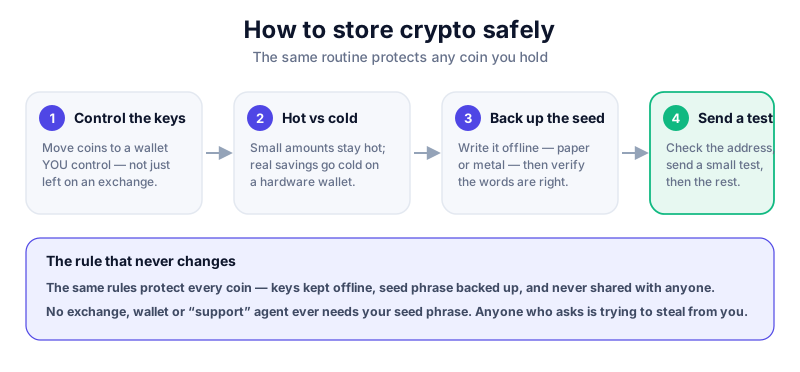
Small amounts can live on a reputable exchange or phone wallet. For anything you'd be upset to lose, move it to a hardware wallet and write your seed phrase on paper, stored offline. Never share that phrase with anyone, ever — not even 'support', not even someone who seems to already know things about you.
It's all about the keys
Here's the idea that makes everything else click. Your Bitcoin never actually 'leaves' the blockchain — it isn't a file sitting on your phone that a thief could grab. What you really store are the keys that prove the coins are yours and let you spend them. Whoever controls the keys controls the coins, which is why 'not your keys, not your coins' is the most repeated phrase in all of crypto. Storing Bitcoin safely is, in plain terms, the art of keeping those keys both safe from thieves and recoverable by you — and balancing those two needs is the whole job.
In practice, your keys are usually backed up as a seed phrase — a list of 12 to 24 ordinary words your wallet generates when you set it up. Those words can rebuild your entire wallet on any device, anywhere in the world. That's brilliant for recovery and catastrophic if it falls into the wrong hands, because the same words that save you can rob you. So the whole game comes down to protecting that phrase. We cover it in depth in what is a seed phrase, and it's worth reading once you've finished here.
Never share your seed phrase
Your seed phrase can restore your entire wallet and move every coin in it. No exchange, wallet, or support agent will ever need it or ask for it. Anyone who does — by email, DM, phone or pop-up — is trying to steal from you. There are no exceptions to this rule, and treating it as absolute will protect you.
Hot wallets vs cold wallets
Wallets come in two broad types, and most people end up using both — a hot wallet for spending money, and a cold wallet for savings. The simplest way to picture it: a hot wallet is the cash in your pocket, handy but exposed; a cold wallet is the safe at home, less convenient but far harder to rob. You wouldn't carry your life savings around in your back pocket, and the same logic applies here. For the cold side, a simple hardware wallet like the BitBox02 keeps your keys offline.
- Hot wallets are connected to the internet — typically a phone or browser app. They're convenient for small, everyday amounts, but being online means more exposure to malware, phishing and hacks.
- Cold wallets keep your keys completely offline — a hardware device or a paper backup. They're less convenient day-to-day but are the safest place for larger holdings you don't touch often.
Neither is 'better' in the abstract — they're tools for different jobs, like a wallet and a safe. The skill is matching the wallet to the amount, which is exactly what the next lesson, Bitcoin wallets explained, digs into. For a focused side-by-side, hot vs cold wallets compares the two camps directly.

How to set up safe storage
Here's a sensible, beginner-friendly routine for moving from 'it's on the exchange' to 'it's properly yours'. Take it slowly — every step exists to remove a specific way people lose money. None of it is hard; it just rewards patience over speed.
- Decide how much you're protecting. Pocket money can stay on a reputable exchange; serious savings should move to a hardware wallet.
- Buy a hardware wallet from the manufacturer directly — never second-hand or from a marketplace, which risks a tampered device. Our how to set up a Ledger guide walks the process.
- Set it up yourself and let the device generate a brand-new seed phrase. Write it on paper by hand as it appears on screen, double-checking the spelling.
- Store the paper offline in a safe place — ideally two copies in two separate locations. Never photograph it or type it into a computer or phone.
- Send a small test amount first, confirm it arrives in your wallet, then move the rest once you're satisfied it all works.
The Ledger Nano X keeps your keys on a secure chip and supports thousands of coins. We may earn a commission at no cost to you, and it never changes our verdicts. Compare it against Trezor in Ledger vs Trezor before you buy.
Common mistakes to avoid
Almost every avoidable loss comes from one of a few classic slips. None of them require a sophisticated hacker — just a moment of convenience or carelessness on an ordinary day. Read this list twice, because future-you will thank present-you.
- Storing your seed phrase as a photo, screenshot, or note on your phone — the first thing malware and cloud breaches hunt for, and a depressingly common way people lose everything.
- Keeping large amounts on an exchange long-term, where you don't control the keys and a single failure isn't yours to fix.
- Buying a 'pre-configured' wallet that arrived with a seed phrase already written down — that's a classic theft setup; a genuine device always makes you generate your own.
- Telling anyone how much you hold or where you store it, online or off. Discretion is part of security.
If you ever feel rushed
Scammers manufacture urgency on purpose, because panic stops people thinking clearly. Any message pushing you to move funds 'right now', 'verify your wallet', or 'secure your account immediately' is a red flag. Slow down, close the message, and check independently through a channel you trust.
Where to go next
You've now got the core storage skills: protect the keys, use a hot wallet for spending and a cold wallet for savings, and guard that seed phrase with your life. That's the foundation everything else in self-custody builds on. Next, lesson five — Bitcoin wallets explained — unpacks the different wallet types in more detail so you can pick the right one with confidence. After that we'll tackle security and scams, and finally advanced self-custody for larger holdings. One step at a time.
Key takeaways
- You're really storing keys, not coins — protect the keys above everything else.
- Use a hot wallet for spending and a cold wallet for savings.
- A hardware wallet plus an offline paper seed phrase is the gold standard for most people.
- Never share, photograph or type your seed phrase anywhere — no legitimate service needs it.
Frequently asked questions
Do I really need a hardware wallet?
For small amounts you're learning with, no — a reputable app is fine. For anything you'd be genuinely upset to lose, a hardware wallet is well worth the modest cost and quickly becomes a no-brainer rather than a luxury.
What if I lose my hardware wallet?
Your funds are safe as long as you still have your seed phrase. Buy a new device and restore from the phrase, and your wallet reappears exactly as it was. That's precisely why the phrase, not the gadget, is the thing you guard.
Is it safe to keep crypto on an exchange?
For active trading or small sums, it's convenient. But the exchange holds the keys, so it isn't true self-custody — and exchanges can be hacked, freeze withdrawals, or fail. Larger holdings belong in a wallet you control.
Keep reading
What Is Bitcoin? A Plain-English Guide
A beginner-friendly explanation of what Bitcoin is, how it works, and how to think about it — with no hype and
Bitcoin Wallets Explained
What a Bitcoin wallet really is, the difference between custodial and self-custody, hot vs cold, and how to ch
What Is a Seed Phrase? (And Why You Must Never Share It)
A plain-English guide to seed phrases: what they are, how they back up your crypto wallet, how to store one sa