The Psychology Behind Meme Coin Investing
Meme coins are designed, intentionally or not, to press the buttons our brains find hardest to ignore. The charts, the countdowns, the screenshots of someone turning £100 into a holiday — none of it is really about the technology. It's about how we feel. Understanding the psychology is the single most useful defence you have.
The 20-second version
Meme coins exploit well-known mental shortcuts — FOMO, herd behaviour, social proof and lottery-ticket thinking — that evolved for survival, not for trading volatile tokens. You can't switch these instincts off, but you can spot them in yourself and build simple rules that take the decision out of the heat of the moment.
Why meme coins hit different
Most investing is slow and boring on purpose. Meme coins are the opposite: fast, loud, funny and social. That combination is unusually good at bypassing the careful, deliberate part of your thinking and going straight to the part that reacts. You're not weak-willed for feeling the pull — the format is built to create it, whether by design or by accident of how these markets work.
It helps to remember what you're actually looking at. As we explain in how meme coins work, most of these tokens have no product, no revenue and no fundamentals — the price is just a ratio inside a liquidity pool. When there's nothing solid to analyse, the only thing left to move the price is collective emotion. That's why psychology isn't a side topic here. It's the whole engine.
The biases doing the heavy lifting
A handful of well-documented mental shortcuts do most of the work. None of them are unique to crypto — they show up in gambling, panic-buying and playground crazes too. Naming them makes them easier to catch.
FOMO — the fear of missing out
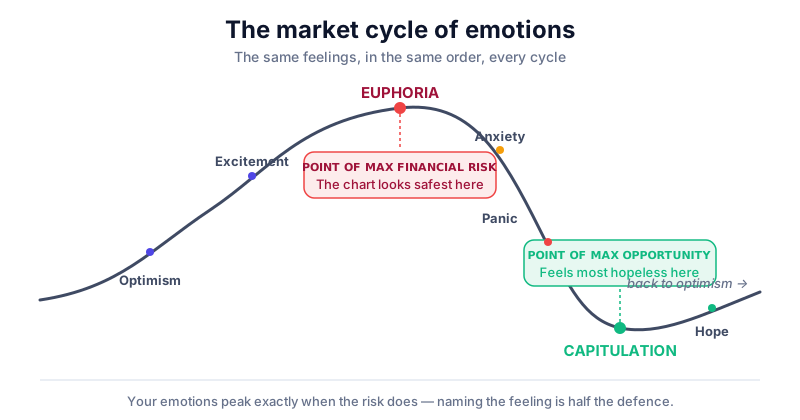
Watching a coin climb while you sit on the sidelines feels almost physically uncomfortable, and that discomfort grows the higher it goes. The cruel twist is that FOMO peaks at exactly the worst moment to buy: after a big run, when the chart looks most exciting and the risk is highest. The people posting their gains rarely post the moment it reverses.
Herd behaviour
We're wired to assume that if lots of people are doing something, it must be safe. In a stampede that instinct can be deadly — and a meme coin going viral is a stampede. The crowd that pulled the price up has no obligation to stick around, and crowds turn far faster than they form.
Social proof and influencers
A coin feels more legitimate when a big account endorses it, a celebrity tweets a ticker, or your group chat won't stop mentioning it. But endorsements are cheap, often paid, and sometimes part of a coordinated pump. A familiar logo and a confident voice are not due diligence. Plenty of these schemes follow the same script as a classic pump-and-dump.
Lottery-ticket thinking
A token priced at a fraction of a penny invites a seductive daydream: what if this is the next big one? Our brains are bad at tiny probabilities and great at imagining huge payoffs, so we focus on the dream and ignore the odds. As what is market cap explains, a low per-token price tells you nothing about how much room a coin has to grow — it's engineered to look affordable.
Sunk cost and loss aversion
Once you're down, the instinct is to hold on — or even buy more — because selling makes the loss feel real and admits you were wrong. Losses also hurt psychologically about twice as much as equivalent gains feel good, which is why people freeze instead of cutting a position. The money you've already spent is gone whatever you do next; it shouldn't decide your next move.
The hype machine is built for this
These biases don't get triggered by accident. The whole environment is shaped to keep them firing — and once you see the pattern, the individual prompts lose a lot of their power.
| The trigger | What it pokes | What's really going on |
|---|---|---|
| "Up only" green candles | FOMO, herd instinct | Early buyers need later buyers to cash out; the chart is the marketing |
| Countdown timers and "last chance" | Scarcity, urgency | Pressure stops you pausing to think or check the contract |
| Screenshots of huge gains | Lottery dreams, envy | Winners get shared; the far larger pile of losers stays quiet |
| "We're all in this together" community | Belonging, social proof | Group identity makes selling feel like betrayal, not a decision |
Survivorship bias is everywhere
Your feed shows you the one person who got rich, not the thousands who didn't. That isn't a representative sample — it's a highlight reel curated by an algorithm that rewards excitement. Judging your odds from screenshots is like judging your chances of stardom from a montage of famous actors.
Practical ways to protect yourself
You can't delete instincts that took millions of years to evolve. What you can do is build a few simple rules in calm moments, so the decision is already made before the emotion arrives. Friction is your friend here — anything that slows you down works in your favour. The same logic applies to storage: keeping any longer-term holdings in cold storage on a Keystone puts a useful pause between you and an impulsive trade.
- Decide your limit before you look at the chart. Set a number you'd be genuinely fine losing entirely, and treat it as already spent. If a position can hurt your rent, food or sleep, it's too big.
- Add a delay. Make yourself wait 24 hours before buying anything you discovered today. Most FOMO doesn't survive a night's sleep.
- Write down your reason. If you can't explain in one sentence why you're buying — without the words 'mooning' or 'everyone' — that's your answer.
- Mute the urgency. Countdown timers and 'last chance' messaging exist to stop you thinking. A genuinely good idea is still good tomorrow.
- Do the boring checks anyway. Even when you're convinced, run the how to research a meme coin checklist. It's also the fastest way to break a spell.
- Expect to lose it. Assume any single meme coin goes to zero. If that assumption changes how much you'd put in, listen to it.
Name the feeling out loud
Simply saying "this is FOMO" or "this is sunk cost" to yourself measurably weakens its grip. You're moving the decision from the reactive part of your brain to the reflective part. It feels almost too simple to work — which is exactly why people skip it.
Where psychology meets fraud
The same emotional buttons that make meme coins exciting are the ones scammers press deliberately. Urgency, social proof and the fear of missing out are the core ingredients of nearly every crypto scam — from rug pulls and honeypot tokens to fake giveaways. The defences overlap almost perfectly, which is why how to avoid crypto scams is worth reading even if you never plan to touch a meme coin.
The takeaway isn't that excitement is bad. It's that excitement is information about your state of mind, not about the asset. When you notice it spiking, that's the moment to slow down — not speed up.
The bottom line
Meme coin markets aren't really tests of analysis — there's usually nothing to analyse. They're tests of temperament. The biases that get exploited, FOMO, herd behaviour, social proof, lottery-ticket dreaming and sunk cost, are universal and unfixable, but they're also predictable. Once you can name them as they happen, and once you've set your limits while calm, you've taken back most of the control the hype machine is designed to remove. Treat any money you put in as money you've already said goodbye to, because crypto is extremely volatile and you can lose everything you put in.
Key takeaways
- Meme coin prices are driven by collective emotion, not fundamentals — so psychology is the whole game.
- FOMO, herd behaviour, social proof, lottery-ticket thinking and sunk cost do most of the damage.
- Your feed shows survivors, not the far larger crowd who lost — that's survivorship bias.
- Set your loss limit and a cooling-off delay while calm, so the emotion arrives after the decision.
- The same buttons meme coins press are the ones scammers use, so the defences are the same.
Frequently asked questions
Why do I feel such a strong urge to buy when a coin is pumping?
That's FOMO — the fear of missing out — and it's a normal, hardwired response to watching others apparently profit. The problem is that it peaks after a big rise, which is statistically the riskiest time to buy. Adding a 24-hour delay before any purchase is the simplest way to let that urge fade before you act.
I'm already down a lot. Should I hold and hope, or sell?
We can't tell you what to do with your money, but we can name the trap: the instinct to hold or 'average down' to avoid admitting a loss is sunk-cost thinking. The money already spent is gone regardless of your next move, so it shouldn't drive that move. Decide based on what you'd do if you held no position at all today.
Does knowing about these biases actually protect me?
Partly. Awareness alone won't switch the instincts off, but naming a feeling as it happens does measurably weaken it. The bigger protection is building simple rules in calm moments — a fixed loss limit, a cooling-off period, a written reason — so the decision is already made before the emotion arrives.
Keep reading
How Meme Coins Work (Under the Hood)
How meme coins are created, traded and priced — tokens, liquidity pools, market caps and the mechanics that ma
Meme Coin Risks and Red Flags
The core safety lesson on meme coins: the real risks, the warning signs to look for, and the scams that separa
What Are Meme Coins? A Plain-English Guide
A clear, no-hype explanation of what meme coins are, where they came from, why they're so risky, and how to th