What Is a Crypto 'Rating' Worth? The ICObench and ICOholder Question
A star rating feels like the ultimate shortcut: someone expert has already done the homework, so you don't have to. In crypto, that instinct is exactly what the rating directories are built to exploit. Sites like ICObench and ICOholder score new projects, rank them, and mark some as 'featured' — and the value of all three depends entirely on a question their glossy scores don't answer: who paid for what? This is a look at how crypto ratings work, drawn from the platforms' own pages and the documented history of the model.
The 20-second version
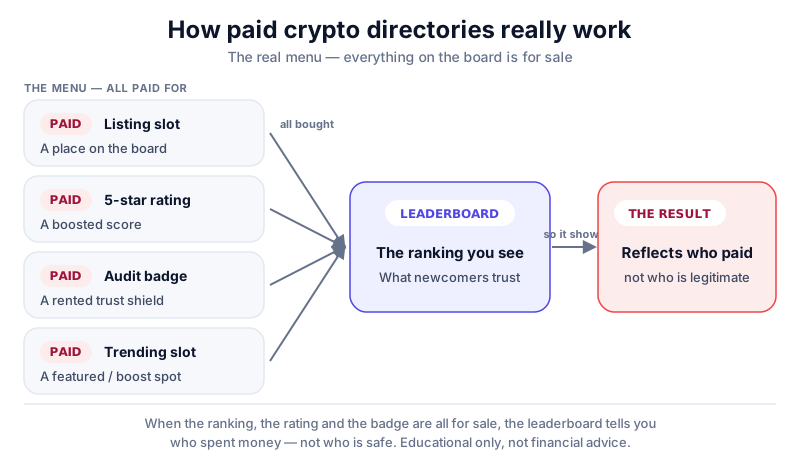
A crypto 'rating' is only as trustworthy as the incentives behind it. ICObench states its ratings *'cannot be purchased'* and that featured listings are separate — a claim worth quoting, and worth reading against the documented history of paid ICO ratings. ICOholder openly sells a menu of promotion, including 30 days 'featured' on its main page and, in its own words, having *'competitors removed from your ICO profile'*. Neither discloses who runs it. Treat scores as a starting point, never a verdict.
What rating directories are
ICObench (icobench.com) and ICOholder (icoholder.com) are directories from the ICO era that rate, list and 'feature' new crypto projects — presales, token sales, early coins. The pitch is authority: ICObench calls itself a place to *'discover emerging ICOs'* with reviews and ratings; ICOholder describes itself as a *'smart tracker, global analytics platform with the largest crypto database'*. The implied promise is independence — that the score means something. Whether it does comes down to a single question we ask of every directory in Scam Watch: what's for sale, and how separate is it from the editorial?
ICOholder: the menu, in its own words
ICOholder is the more straightforward of the two, because its Services page simply lists what money buys. A 'Premium Deluxe' package offers, verbatim, *'Exclusive featuring at the main page during 30 days'* — and, remarkably, *'Competitors removed from your ICO profile'*. Read that twice: a paid product that removes your rivals from your own listing page. It also sells full-width banner ads *'pinned at the top… of all pages, including the Homepage'*, bounty campaigns, submission to *'TOP 150 Trackers'*, outreach to *'over 250 YouTubers'*, and even *'Listing on Exchanges: 20+ Crypto Exchanges within two-three weeks'*. No prices are published — every option is an 'Order Now' that routes to email — but the shape is unmistakable: on this platform, prominence and a curated profile are products.
'Competitors removed'
It's worth dwelling on that one. A directory presenting itself as neutral analytics, selling a package that scrubs rival projects from your page, is the opposite of neutral by design. It's not hidden — it's on the rate card — which is exactly why it belongs in front of you before you trust a listing there.
ICObench: the rating claim, and the history behind it
ICObench leans harder on the idea of a trustworthy *score*. Its own pages describe a *'Dual-Layer Evaluation System that combines algorithmic precision with human expertise'* and a *'weighted rating system to enforce an anti-manipulation protocol'*. Crucially, it makes a direct promise worth quoting in full: *'ratings cannot be purchased. Our "Featured" listings are clearly disclosed and are kept entirely separate from the independent rating scores.'* That is the right thing to claim, and we quote it fairly.
It also has to be read against the documented history of ICO ratings — which is where ICObench's model was, years ago, publicly tested. In June 2018, a researcher, Markus Abbassi, published an investigation for Alethena titled *'This Is How Easy It Is to Buy ICO Ratings'*. In it, he was offered paid expert ratings for figures like *'500 US dollars'* and *'1.5 Ether'*, and ran a now-famous test: he submitted a review whose four paragraphs' opening letters spelled out S-C-A-M — and reported that a listed 'expert' published it verbatim. Two things must be said precisely about this. First, the concrete, proven finding was that individual people listed as ratings 'experts' accepted payment to publish ratings — a failure of the expert model. Second, and by the reporter's own explicit admission, he *could not establish* that the people offering those paid ratings were connected to ICObench the company. We report it as exactly that: a documented, attributed episode about the ICO-rating model, from 2018, not a finding against the current company — which today states plainly that ratings can't be bought.
The general lesson, not a verdict
The takeaway isn't 'this one directory is corrupt'. It's that a rating produced by paid or incentivised reviewers is worth nothing, wherever it appears — and that the only way to know is transparency about the incentives. Claims of an 'anti-manipulation protocol' are reassuring; independently verifiable methodology would be more so.
What neither will tell you
For all their talk of transparency, both platforms are strikingly opaque about themselves. On the pages we reviewed, neither ICObench nor ICOholder discloses a company name, registered address or jurisdiction — only 'a team of crypto experts' and a copyright line. Both carry generic 'this is not investment advice' disclaimers, and ICObench's press-release pages disclose that *'some of the links… may be affiliate links'* earning commissions. Neither shows the FCA-prescribed risk warning that a compliant UK crypto promotion requires — a gap you'll now recognise from every directory we've examined. A site asking you to trust its scores, while telling you nothing about who produces them, has the transparency equation backwards.
In fairness
Some balance is owed. ICObench explicitly claims its ratings can't be bought and that featured placements are disclosed and separate — and the events described above are from 2018, a different era of the ICO market. Both sites carry risk disclaimers. Rating and listing services are not inherently illegitimate; plenty of media survives on advertising without selling its conclusions. Our point is narrower and older than any single company: a score you can't audit, from a rater you can't identify, sitting next to a menu of paid 'featured' placements, cannot carry the weight newcomers instinctively give it. Use the number as a prompt to investigate — never as the investigation.
How to use ratings safely — and how we checked
Treat every crypto rating, badge and 'featured' slot as advertising until proven otherwise — the same rule from our paid-listings guide and our looks at Coin Gabbar and the vote-and-boost directories. Then do the checks a rating can never replace and no directory can sell: the team, the whitepaper, a real audit, and the on-chain money.
How we checked (5 July 2026): direct review of icobench.com and icoholder.com — their homepages, about/methodology and services pages, and disclaimers — quoted verbatim; and, for the historical section, Markus Abbassi's June 2018 Alethena investigation, attributed and presented with the author's own stated limits. Some pages could not be retrieved and are not relied upon. We make no claim linking either platform to any regulatory enforcement action. This is independent editorial commentary in the public interest — not an allegation of unlawful conduct, and not financial advice. If you represent ICObench or ICOholder and believe anything here is inaccurate, email hello@latestcrypto.co.uk with verifiable evidence and we will review and correct promptly.
Key takeaways
- A crypto rating is only as trustworthy as the incentives behind it — audit those, not the stars
- ICOholder's own Services page sells 30-day 'featuring' and, verbatim, 'competitors removed from your ICO profile'
- ICObench states ratings 'cannot be purchased' — quote it fairly, and read it against the documented 2018 history
- The 2018 Alethena investigation proved individual 'experts' took payment; the reporter could not tie them to the company
- Neither platform discloses who runs it — trust the checks you can do yourself, not an anonymous score
Frequently asked questions
Can I trust an ICObench or ICOholder rating?
Treat it as a starting point, not a verdict. ICObench says its ratings can't be bought; ICOholder openly sells 'featured' placement and profile curation. Either way, a score from a rater who won't say who they are can't replace checking the team, audit and on-chain money yourself.
Did ICObench sell fake ratings?
We don't say that. What's documented — in Markus Abbassi's June 2018 Alethena investigation — is that individual people listed as ratings 'experts' accepted payment to publish ratings (including one that spelled 'SCAM'). The reporter expressly could not establish that those paid parties were connected to ICObench the company, and ICObench today states ratings cannot be purchased.
Is a 'featured' project on these sites safer than a non-featured one?
No — on ICOholder, 'featured' is a paid product by its own description, and paid prominence tells you nothing about a project's honesty. Judge featured and non-featured projects by the same free, verifiable checks.
Keep reading
The 'Boost' Economy: When a Crypto Leaderboard Is Something You Buy
Directories like CoinSniper and CoinMooner rank tokens by 'community votes' — while selling the rank itself as
Votes for Sale: How Crypto 'Community Ranking' Sites Really Work
Sites like CoinVote and CoinHunt rank tokens by 'community votes' — while third-party sellers openly retail th
How Coin Gabbar's Paid Listings Really Work — In Its Own Words
Coin Gabbar's own pages describe paid listing promotion, a press-release product with refunds, and 'featured'