Crypto Myths Debunked: 15 Things Beginners Get Wrong
Crypto's real risks are serious enough that you don't need the fake ones — and yet the myths are everywhere, pulling beginners in two opposite directions. One set is pure hype ('it's free money', 'you're too late'). The other is scare-story folklore ('it's all a scam', 'blockchain is unhackable'). Both get people hurt. This is a plain-English roundup of fifteen things beginners routinely get wrong, sorting what's genuinely true from what's nonsense — so you walk away calibrated rather than either terrified or over-confident. It's education, not financial advice, and we're never going to tell you what to buy.
The 20-second version
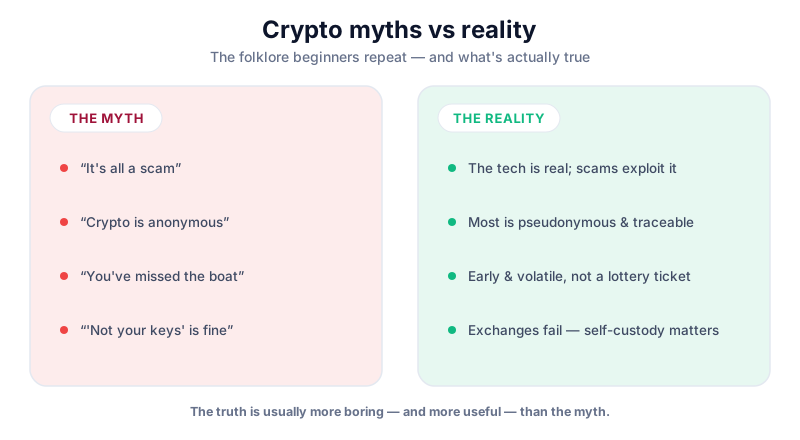
Most crypto 'facts' beginners repeat are half-right at best. Crypto isn't anonymous, blockchains aren't unhackable, a hardware wallet doesn't 'store your coins', and there's no forgot-password button. Equally, it isn't all a scam and it isn't automatically 'too late'. The honest takeaway: the myths get corrected, but every real risk — irreversible payments, scams, volatility, total loss — stays firmly on the table.
The "it's all a scam / it's fake money" myths
The loudest myth is that crypto is *nothing but* criminals and fraud. The data says otherwise — but not in a comforting way. According to the latest Chainalysis crime report, illicit activity has consistently stayed under 1% of attributed on-chain volume; the honest catch is that in absolute terms it's still enormous and growing, with illicit flows estimated at record levels and crypto scams alone taking in roughly $14 billion in the most recent figures (these numbers move with every report, so treat them as ballpark and date-check before quoting).
So 'it's all a scam' is wrong — but don't let that lull you. A small *percentage* of a massive market is still a jaw-dropping amount of stolen money, and beginners are prime targets. The correct reading isn't 'crypto is safe'; it's 'the fraud is real, concentrated, and aimed at newcomers'. Learning how to avoid crypto scams matters far more than debating the headline percentage.
Myth two: 'it has no intrinsic value, so it's fake money.' This cuts both ways. Value comes from utility, scarcity and trust — the very same forces that prop up ordinary currency (the US dollar has had no gold backing since 1971). That's not an endorsement of any coin; most tokens genuinely are worthless and will go to zero. It just means 'no intrinsic value' is a lazy dismissal that misunderstands how *all* money works, fiat included.
Myth three, the mirror image: 'an exchange is basically a bank.' It isn't. When FTX collapsed in 2022, customers learned the hard way that 'trust us, the funds are there' can be worth nothing. In the US, the FDIC doesn't insure crypto and has ordered platforms to stop implying it does. For a UK reader the equivalent is starker: crypto largely sits outside FSCS protection, and the FCA's rules warn you can lose everything. The old line holds — *not your keys, not your coins.*
The privacy & security myths
Myth four: 'crypto is anonymous.' It's pseudonymous, which is a very different thing. Every Bitcoin transaction lives on a permanent public ledger forever. Analytics firms cluster addresses and combine them with the identity checks (KYC) that regulated exchanges already hold, routinely linking wallets to real people — the US Department of Justice has used exactly this to trace stolen crypto. Your wallet is a pseudonym, not a mask, and once it's tied to your name, the whole history is visible. Basic crypto opsec helps, but assume the ledger is public, because it is.
Myth five: 'blockchain is unhackable.' The base layers of Bitcoin and Ethereum do have genuinely strong consensus security — that part is fair. But 'the network is hard to attack' has been quietly stretched into 'crypto can't be hacked', which is flatly false. Smaller chains have suffered 51% attacks (Ethereum Classic had millions double-spent). And the real loss surface isn't the base layer at all — it's smart contracts, cross-chain bridges and exchanges. In November 2025, a single rounding-error exploit reportedly drained around $120 million from one DeFi protocol.
"Secure blockchain" is not "secure you"
The strength of Bitcoin's network does nothing to stop you approving a malicious transaction or connecting your wallet to a booby-trapped site. Wallet-drainer scams don't 'hack the blockchain' — they trick you into signing away your own funds, and the blockchain faithfully carries out your instruction. The chain working perfectly is exactly how you lose everything.
The self-custody myths
Myth six: 'a hardware wallet stores my coins.' It doesn't — and this trips up almost everyone. Your coins never leave the blockchain; they can't. What a hardware wallet actually holds is your private keys — the secret that authorises moving those coins — kept offline where malware can't reach them. Think of it as the key to a safe deposit box, not the box itself. If you decide to self-custody, an offline device is the sensible way to keep those keys off an internet-connected computer. Our hot vs cold wallets and hardware vs software wallets guides go deeper on the trade-offs.
A hardware wallet like the Ledger Nano X keeps your private keys off any internet-connected device — it doesn't 'store coins', it guards the keys that authorise moving them. This is a tool for self-custody, not investment advice; only you can decide whether self-custody is right for you.
Myth seven: 'there's a forgot-password button.' There is not. Your seed phrase — the string of words you're told to write down and never share — is the master backup for a non-custodial wallet. Lose it with no other backup and the funds are simply gone; no company, support line or 'recovery expert' can restore a wallet they don't control. Estimates suggest roughly a fifth of all mined Bitcoin is already permanently lost this way.
Myth eight: 'a transaction can be reversed if I made a mistake.' No on-chain payment can be undone — send to the wrong address, or fall for a fake support agent, and it's final. This is why the single most common follow-up scam is a 'recovery service' promising to claw back lost funds for an upfront fee. It's almost always a second theft dressed up as a rescue. If someone offers to reverse a completed crypto transaction, that offer is the scam.
The "get rich" myths
Myth nine: 'a cheap coin has more room to grow.' This is unit bias, and it's engineered to fool you. A coin priced at $0.001 is not 'cheaper' than Bitcoin in any meaningful sense — what matters is the market cap (unit price multiplied by circulating supply), not the sticker price. Projects deliberately mint colossal supplies precisely so the per-coin price looks tiny and tempting. Understanding tokenomics is the antidote; the sticker price on its own tells you almost nothing.
Myth ten: 'staking is free money.' It isn't free and it isn't guaranteed. Real risks include slashing (validator penalties that can dock your stake), lock-up periods where you can't sell during a crash even as the price falls off a cliff, and plain volatility — a 6% yield means nothing if the token drops 50%. A quoted APY is a hope, not a promise. See our Ethereum staking guide for how the mechanics and the risks actually work.
Myth eleven: 'a stablecoin is always worth a dollar.' The word 'stable' is a design goal, not a law. TerraUSD collapsed from $1 to pennies in May 2022 and never recovered, wiping out tens of billions. Even a large, asset-backed coin like USDC briefly slipped to around $0.88 in March 2023 during a banking scare before recovering. The quality of the backing decides whether a wobble is a blip or a wipeout — our what is a stablecoin guide breaks down how the peg holds and how it breaks.
Myth twelve: 'it's too late — I've missed it.' Honestly, this one's a hedge in both directions. Adoption is still climbing (surveys suggest roughly 30% of US adults now hold some crypto, and spot ETFs have opened an institutional door), so 'still early' is a defensible claim. But 'still early' is emphatically not 'you'll get rich' — the era of casual 100x returns is largely gone, and this remains a high-risk, high-loss asset class. Correcting the pessimism is not a reason to buy; it's just a reason not to base decisions on folklore.
The "crypto = Bitcoin" and energy myths
Myth thirteen: 'crypto just means Bitcoin.' Bitcoin was first and remains the largest, but it's one of thousands. There are well over 10,000 actively traded cryptocurrencies (and tens of millions of tokens ever created, the vast majority now dead — CoinGecko has reported that more than half of all listed cryptos have failed). Ethereum and others are examples of the wider category, not recommendations. Bitcoin and Ethereum together make up roughly three-quarters of total market value at the time of writing, and those dominance figures shift constantly. If the difference between a coin and a token is fuzzy, start with coin vs token.
Myth fourteen: 'crypto is an environmental disaster.' The energy debate is really a Bitcoin debate, because Bitcoin uses proof-of-work mining. Most of crypto by volume now runs on low-energy consensus instead: Ethereum's 2022 switch to proof-of-stake is widely estimated to have cut its energy use by more than 99% (a figure some critics dispute, so treat it as the commonly cited estimate rather than settled fact). For Bitcoin itself, a 2025 Cambridge study estimated a little over half of mining electricity comes from sustainable or low-carbon sources — a number that varies a lot by report and method, so date-check it.
Debunking a fear isn't a green light
Correcting 'blockchain is unhackable' or 'crypto is all criminals' removes a bad reason to fear crypto — it doesn't hand you a good reason to buy it. The genuine risks (irreversible payments, scams, brutal volatility, total loss) are exactly as real after reading this as before. Calibrated, not comfortable, is the goal.
The myths that could cost you money
Myth fifteen and the most expensive: 'crypto gains are tax-free in the UK.' They aren't. HMRC treats selling, swapping or spending cryptoassets as a Capital Gains Tax disposal, and treats earnings like staking or mining rewards as income. For the 2025/26 tax year the CGT annual exempt amount is £3,000 (it has been cut sharply in recent years, so confirm the current figure). And from January 2026, UK platforms are required to report user data to HMRC under the CARF rules — so 'they'll never know' is not a plan. Our UK crypto tax guide and CGT allowance and rates explainer cover the specifics; good tax software can do the record-keeping for you.
A close cousin, worth repeating because it costs people everything: 'my exchange balance is protected like a bank deposit.' It generally isn't. Crypto held on an exchange sits largely outside FSCS protection, and if the platform fails, you're an unsecured creditor waiting in a queue. The FCA's rules spell out how limited your protections are — worth reading before you assume anyone has your back.
Finally, the myth that keeps curious beginners out entirely: 'you need a lot of money, or you need to be technical.' Neither is true. Coins are divisible into tiny fractions — you can buy a few pounds' worth — and modern wallets and apps are genuinely beginner-friendly. The real barrier today isn't the mechanics; it's understanding the risks. Our beginner wallet guide is a gentle place to start once you've decided you actually want to.
Key takeaways
- Crypto is pseudonymous, not anonymous — the public ledger is permanent and wallets get traced to real identities.
- Blockchains aren't 'unhackable'; the real losses come from smart contracts, bridges, exchanges and you signing bad transactions.
- A hardware wallet protects your keys, not 'stores your coins' — and there's no forgot-password button or way to reverse a payment.
- 'Cheap coin', 'free staking' and 'always $1 stablecoin' are all traps; market cap, slashing risk and backing quality are what matter.
- UK crypto gains are taxable, exchange balances largely aren't FSCS-protected, and debunking a fear is never a reason to buy.
Frequently asked questions
Is crypto really anonymous?
No — it's pseudonymous. Every Bitcoin or Ethereum transaction is recorded on a permanent public ledger, and analytics firms combine on-chain data with the identity checks exchanges hold to link wallets to real people. Law enforcement uses exactly this to trace stolen funds. Your wallet is a pseudonym, not a disguise.
If I lose my seed phrase, can I get my crypto back?
For a non-custodial wallet, no. The seed phrase is the master backup, and no company, support line or 'recovery service' can restore a wallet they don't control. Anyone promising to recover lost self-custodied funds for an upfront fee is almost certainly running a scam. Estimates suggest roughly a fifth of all mined Bitcoin is already lost this way.
Is it too late to get into crypto in 2026?
Honestly, it's mixed. Adoption is still growing and institutions have moved in, so 'you've completely missed it' isn't accurate. But the era of easy outsized returns is largely over, and crypto remains high-risk with a real chance of total loss. 'Still early' is not the same as 'you'll get rich', and this isn't a recommendation to buy — just a correction of the folklore.
Do I have to pay tax on crypto in the UK?
Yes. HMRC treats selling, swapping or spending cryptoassets as a Capital Gains Tax disposal, with gains above the annual exempt amount (£3,000 for the 2025/26 tax year — confirm the current figure) potentially taxable. Earnings such as staking or mining rewards are taxed as income. From January 2026, UK platforms must report user data to HMRC under CARF.
Keep reading
Hot vs Cold Wallets: What's the Difference?
A plain-English hot vs cold wallets comparison — how each works, the security trade-offs, and how to combine b
How to Avoid Crypto Scams: The Cornerstone Safety Guide
The common crypto scams — fake support, phishing, giveaways, romance and rug pulls — and the simple habits tha
What Is a Stablecoin? How the Peg Works (and Fails)
A clear guide to stablecoins: how they aim to hold a steady value, the different types, and the very real peg