Hyperliquid Explained: The On-Chain Perps Exchange
Hyperliquid is one of the most talked-about projects in crypto: a decentralised exchange for perpetual futures that runs on its own blockchain and keeps the whole order book on-chain. That combination is unusual, and it has made Hyperliquid the dominant venue for on-chain perps. This guide explains what it actually is, how the parts fit together, and — just as important — why leveraged trading on any platform is one of the fastest ways to lose money.
The 20-second version
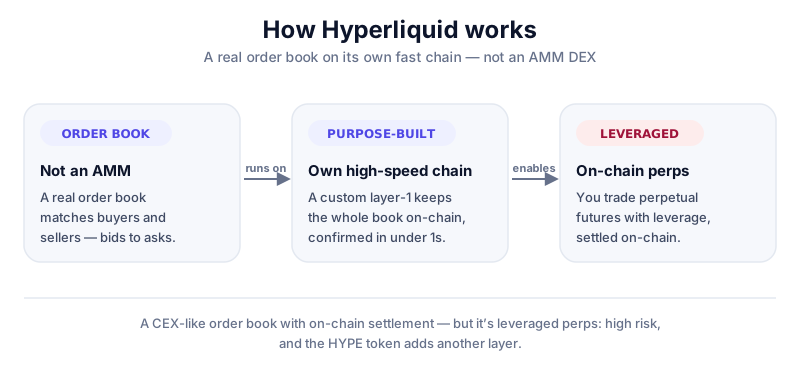
Hyperliquid is a perpetuals DEX built on its own custom layer-1 blockchain, using a fully on-chain order book rather than the liquidity-pool model most DEXs use. It runs on the HYPE token. The technology is genuinely fast, but it exists to offer high-leverage trading, which carries a real risk of total loss.
What Hyperliquid actually is
Hyperliquid is a decentralised exchange focused on perpetual futures — contracts that let traders bet on the price of an asset with leverage, without ever holding the asset itself. We unpack that contract type in detail in what is a perpetual DEX, and it's worth reading first if the term is new to you. The short version: a 'perp' is a derivative that tracks a coin's price and never expires, so traders can hold a leveraged position open indefinitely as long as they keep enough margin.
What makes Hyperliquid stand out is that it isn't an app sitting on top of someone else's chain. The team built a purpose-built layer-1 blockchain specifically to run the exchange. Everything the exchange does — placing orders, cancelling them, matching trades, liquidating positions and settling them — happens on that chain. By 2026 it had grown into the largest venue for on-chain perpetuals trading, regularly settling more perp volume than any other DEX.
Perps are an advanced product
Perpetual futures with leverage are not a beginner instrument. They can lose more, faster, than simply buying a coin. This article explains how Hyperliquid works — it is not a suggestion to trade on it.
On-chain order book, not an AMM
Most DEXs you'll have heard of — Uniswap and the like — use an automated market maker (AMM). You trade against a liquidity pool rather than another person, and the price is set by a formula based on what's in the pool. That design is elegant and permissionless, but it isn't how professional traders are used to working.
Hyperliquid takes the other approach. It runs a fully on-chain central limit order book — the same matching model that powers traditional stock and futures exchanges, and the model behind order books on big centralised exchanges. Buyers and sellers post bids and asks, and the exchange matches them. The difference here is that every one of those orders lives on the blockchain and is visible to anyone, rather than sitting on a company's private servers.
Why that choice matters
- Familiar to traders — limit orders, market orders and tight spreads work the way active traders expect, which AMMs handle clumsily.
- Transparency — because the book is on-chain, liquidations and trades are publicly auditable rather than happening behind closed doors.
- The hard part — keeping a high-speed order book entirely on-chain is technically demanding, which is exactly why Hyperliquid built its own chain to do it.
| AMM DEX (e.g. Uniswap) | Hyperliquid | |
|---|---|---|
| How you trade | Against a liquidity pool | Against other traders' orders |
| Price set by | A pool formula | Matched bids and asks |
| Main use | Spot token swaps | Leveraged perpetual futures |
| Where it runs | On a general-purpose chain | Its own custom layer-1 |
How the technology fits together
The chain uses a consensus mechanism the team calls HyperBFT, derived from a well-known design called HotStuff. The aim is speed: the network targets very fast block times and high throughput so that the order book can update almost instantly, with trades confirmed in well under a second. That responsiveness is what lets an on-chain exchange feel competitive with a centralised one.
The system is split into two parts. HyperCore runs the exchange itself — the perpetual and spot order books, matching and settlement. HyperEVM, launched in early 2025, is an Ethereum-compatible layer that lets developers deploy smart contracts and build apps that tap into HyperCore's liquidity. In practice that means Hyperliquid is trying to be both a high-performance exchange and a broader platform other projects can build on.
One specialised chain, two jobs
Think of HyperCore as the trading engine and HyperEVM as the developer playground bolted onto it. Most of the volume and attention is on the trading engine; the EVM side is the bet on becoming an ecosystem rather than a single app.
The HYPE token
HYPE is the chain's native asset, and it does a few jobs at once. It pays gas fees on HyperEVM, it secures the network through staking — holders delegate to a set of validators that produce blocks — and the protocol channels the large majority of its trading fees into buying HYPE back on the open market. Understanding those mechanics is really an exercise in reading the project's tokenomics, not a verdict on whether the token is a good or bad thing to hold.
The launch was unusual and is part of why the project gets so much attention. In late 2024, HYPE was distributed through a large community airdrop rather than a sale to venture-capital investors, with the bulk of supply earmarked for users and core-contributor allocations locked for years. Skipping VC funding was a deliberate, much-publicised choice — but a fairer-sounding launch doesn't remove the underlying risks of the token or the product.
- Gas — HYPE pays transaction fees on the HyperEVM side.
- Staking and security — holders delegate HYPE to validators that secure the chain.
- Fee buybacks — most trading fees fund open-market purchases of HYPE.
- Concentration risk — as with any token, who holds the supply and what unlocks when both matter; large locked allocations can affect the market when they release.
The risks you can't skip
It's easy to get swept up in Hyperliquid's growth story and forget what the platform is for. At its core it offers leveraged trading, and leverage is a magnifier in both directions. A position with 10x leverage doubles your money on a 10% favourable move — and wipes it out entirely on a 10% move against you. Liquidations on perps are fast and unforgiving; a sharp wick in the price can close your position before you can react.
Risks specific to this kind of platform
- Leverage and liquidation — most people who trade perps with high leverage lose money. The faster the venue, the faster you can be liquidated.
- Smart-contract and chain risk — a custom layer-1 and on-chain order book is novel software. Bugs, exploits or smart-contract risk are always possible with newer systems.
- Self-custody and operational risk — you trade from your own wallet, so phishing, wallet drainers and signing a malicious transaction can cost you everything with no support desk to call.
- Regulatory uncertainty — perpetual futures are a restricted or banned product for retail users in many places. In the UK, leveraged crypto derivatives for retail consumers face heavy FCA restrictions; check what's legal where you live.
This is among the highest-risk corners of crypto
Trading on-chain perpetuals combines volatile assets, leverage and self-custody — three of the biggest ways to lose money in crypto, stacked on top of each other. Nothing here is a recommendation to trade; it's an explanation of how the system works.
The bottom line
Hyperliquid is a genuinely interesting piece of engineering: it pushed an on-chain order book to a speed that earlier projects couldn't reach, and it did so on a blockchain built for that single purpose. That's why it became the leading venue for on-chain perpetuals and a frequent talking point in the wider debate about where decentralised exchanges are heading. If you want to understand modern crypto market structure, it's worth knowing what it is and how it differs from the CEX-versus-DEX trade-offs people usually discuss.
But understanding a platform and trading on it are very different things. Perpetual futures with leverage are an advanced, high-risk product that can lose you more than a simple purchase ever would — and crypto is volatile enough already. Treat this as education. Crypto prices can move violently, leverage magnifies that, and you can lose your entire stake. A hardware wallet that displays exactly what you're approving — like the Keystone — turns most signing mistakes into near-misses.
Key takeaways
- Hyperliquid is a perpetuals DEX running on its own custom layer-1 blockchain.
- It uses a fully on-chain order book rather than the AMM/liquidity-pool model most DEXs use.
- HYPE is the native token, used for gas, staking and fee-funded buybacks; it launched via a community airdrop, not a VC sale.
- Leveraged perps are an advanced, high-risk product — you can lose your entire stake, and they're restricted for UK retail users.
Frequently asked questions
How is Hyperliquid different from a normal DEX like Uniswap?
Uniswap is an AMM where you trade against a liquidity pool at a price set by a formula, mainly for spot swaps. Hyperliquid uses an on-chain order book matching buyers and sellers directly, and it focuses on leveraged perpetual futures rather than simple swaps. It also runs on its own purpose-built chain rather than on top of a general-purpose one.
What is the HYPE token for?
HYPE is the native asset of Hyperliquid's blockchain. It pays gas fees on the HyperEVM layer, secures the network through staking, and most of the protocol's trading fees are used to buy HYPE back on the open market. It launched through a community airdrop in late 2024 rather than a sale to venture investors.
Is trading on Hyperliquid safe?
The platform is a serious piece of engineering, but the product it offers — leveraged perpetual futures — is one of the highest-risk activities in crypto. Leverage can wipe out your position on a small adverse move, you're responsible for your own wallet security, and these derivatives are restricted for retail users in the UK and elsewhere. Most people who trade leveraged perps lose money.
Keep reading
What Is a Perpetual DEX? Perps Trading Explained
A plain-English guide to perpetual DEXs: how on-chain perps work, funding rates, leverage and liquidation, and
What Is a DEX? Decentralised Exchanges Explained
A plain-English guide to decentralised exchanges (DEXs): how they let you swap tokens without an account, how
CEX vs DEX (2026): Centralised vs Decentralised Exchanges
Centralised vs decentralised exchanges explained: custody, fees, security, ease of use and trade-offs — so you