The Future of Decentralised Exchanges
Decentralised exchanges started as clunky experiments and have grown into a serious part of how crypto trades. The next few years are less about a single breakthrough and more about a series of refinements — better matching, smarter routing and a smoother experience — that are quietly closing the gap with centralised exchanges. This guide walks through the main directions DEXs are heading, and the honest trade-offs that mean they won't suit everyone.
The 20-second version
DEXs are evolving along several fronts at once: on-chain order books, leveraged perpetuals, 'intents' that let you state a goal instead of a path, smarter aggregators, and friendlier interfaces. They're getting faster and easier — but custody, complexity and regulation remain real trade-offs versus centralised platforms.
Where DEXs are today
A decentralised exchange lets you trade crypto directly from your own wallet, without handing your coins to a company first. For years the dominant design was the automated market maker (AMM), where you trade against a liquidity pool instead of another person. AMMs unlocked permissionless trading for any token, but they were never a great fit for active traders or large orders.
That's changing. DEXs have grown from experimental AMMs into the hub of on-chain trading, and the boundary between them and centralised exchanges is getting blurrier. Several order-book venues now use AMM-style passive pools, and several AMM venues now offer order-book-style matching. The rest of this guide is about the specific directions that convergence is taking.
On-chain order books and perps
The biggest shift is the rise of fully on-chain order books — the bid-and-ask matching model that traditional exchanges use, brought on-chain so it's transparent and self-custodial. This is the model behind order books generally, and it suits active trading far better than a pool formula does. Venues like Hyperliquid built entire custom blockchains to make on-chain order books fast enough to compete with centralised platforms.
Hand in hand with that is the growth of perpetual futures on-chain. A perpetual DEX lets traders take leveraged positions that never expire, entirely from their own wallet. These venues now process tens of billions of dollars in daily volume. The next round of innovation is focused on cross-margin systems, shared liquidity across chains and more capital-efficient designs — but it's worth being blunt about what this product is.
Perps are high-risk, not a headline feature
Leveraged perpetual futures can lose you more than you put in, fast, and are restricted for retail users in the UK and many other places. The fact that DEXs now offer them is a market-structure development, not a reason to trade them.
Intents: stating a goal, not a path
One of the more interesting ideas gaining ground is intents-based trading. Today, when you swap tokens on a DEX, you specify the exact path: which pool, which route, how much slippage you'll tolerate. An intents model flips that around. You sign a statement of the *outcome* you want — 'I'll give up to X of this for at least Y of that' — and a competitive network of solvers figures out the best way to make it happen.
Why this matters
- Better prices — solvers compete to fill your order, drawing on pools, order books, market-maker inventory and even cross-chain routes you'd never assemble yourself.
- Fewer failed trades — you set constraints like maximum slippage, and the solver only fills if it can meet them.
- Less to think about — you don't need to understand routing or pick a pool; you just state what you want.
- A new trust assumption — you're relying on solvers to behave competitively, which adds a layer to understand, including exposure to MEV if a design is sloppy.
Aggregators and a smoother experience
Liquidity in DeFi is fragmented across dozens of pools and many chains. Aggregators solve this by splitting a single trade across multiple venues to find the best overall price, and they've become standard infrastructure. Intents and aggregators are converging: both are ways of hiding routing complexity from you so a trade 'just works'.
Alongside that, the plumbing is getting friendlier. Better bridging between chains, gas paid in the token you're trading, clearer transaction previews and simpler wallets are all chipping away at the friction that historically made DEXs intimidating. None of it removes the core responsibility of self-custody, but it lowers the number of ways a beginner can trip up.
Convenience doesn't remove the risks
Smoother UX is welcome, but it can also lull you into signing transactions you don't understand. Knowing how to revoke token approvals and how to spot a wallet drainer matters more, not less, as DEXs get easier to use.
The trade-offs versus CEXs
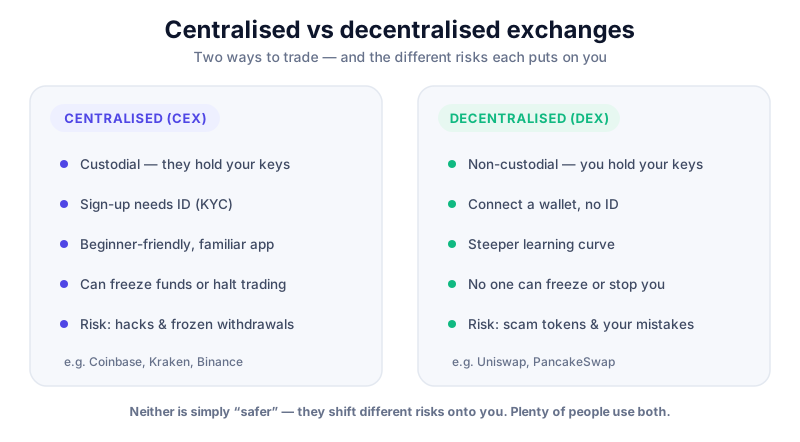
For all the progress, DEXs are not strictly better than centralised exchanges — they're different, with a genuine set of trade-offs we cover in full in CEX versus DEX. The headline advantage of a DEX is self-custody: you keep control of your coins, which removes the risk of an exchange collapsing with your funds, as several infamously have. The headline cost is that the responsibility lands entirely on you.
| DEX strengths | What CEXs still do better | |
|---|---|---|
| Custody | You hold your own keys | They handle storage (but you trust them) |
| Access | Permissionless, any token | Curated listings, fiat on-ramps |
| Support | None — you're on your own | Help desks, account recovery |
| Ease | Improving, still fiddly | Polished, beginner-friendly |
| Compliance | Often unregulated | KYC and regulatory cover |
Regulation is the wild card. Rules like the UK's FCA regime and the EU's MiCA framework are still working out how decentralised, non-custodial venues fit in. How that lands will shape which features reach ordinary users and which stay the preserve of advanced traders.
The bottom line
The future of decentralised exchanges isn't one dramatic leap; it's a steady accumulation of improvements — on-chain order books, perps, intents, aggregation and better UX — that together make trading from your own wallet faster and less daunting. The line between a DEX and a centralised exchange is blurring, and for some traders the self-custody advantage is decisive. If you want to try one, start with the basics in how to use a DEX and take it slowly.
Just keep the trade-offs in view. Better tools don't change the fact that you're responsible for your own security, that newer designs carry smart-contract risk, and that some of the flashiest features — leveraged perps especially — are genuinely dangerous. Crypto is volatile, mistakes on a DEX are usually irreversible, and you can lose money. Treat the technology as something to understand first and use cautiously second.
Key takeaways
- DEXs are evolving toward on-chain order books, on-chain perps, intents and smarter aggregation, narrowing the gap with centralised exchanges.
- Intents let you state a desired outcome and have solvers compete to fill it, rather than picking a route yourself.
- Better UX is welcome but doesn't remove the core responsibility of self-custody.
- DEXs and CEXs involve real trade-offs around custody, support and regulation — neither is simply 'better'.
Frequently asked questions
Will DEXs replace centralised exchanges?
Probably not entirely. They're converging — DEXs are getting faster and easier while borrowing ideas from centralised venues — but each keeps a clear advantage. DEXs offer self-custody and permissionless access; centralised exchanges offer support, fiat on-ramps and regulatory cover. Most people will likely keep using both for different things. See CEX versus DEX for the full comparison.
What does 'intents-based' trading mean?
Instead of specifying the exact route for a trade, you sign a statement of the outcome you want — for example, the minimum amount you'll accept. A competitive network of solvers then finds the best way to fulfil it across pools, order books and even other chains. The aim is better prices and fewer failed transactions, at the cost of trusting solvers to behave competitively.
Are on-chain perpetuals safe to trade?
On-chain perpetual futures are one of the highest-risk products in crypto. Leverage can wipe out your position on a small adverse price move, you're responsible for your own wallet security, and these derivatives are restricted for retail users in the UK and many other countries. The growth of perp DEXs is a notable market-structure trend, but it's not a reason to trade them.
Keep reading
What Is a DEX? Decentralised Exchanges Explained
A plain-English guide to decentralised exchanges (DEXs): how they let you swap tokens without an account, how
What Is a Perpetual DEX? Perps Trading Explained
A plain-English guide to perpetual DEXs: how on-chain perps work, funding rates, leverage and liquidation, and
CEX vs DEX (2026): Centralised vs Decentralised Exchanges
Centralised vs decentralised exchanges explained: custody, fees, security, ease of use and trade-offs — so you