Why Solana Still Dominates Meme Coins
Most people who follow crypto for more than a week notice the same thing: when a meme coin goes viral, it's usually on Solana. That hasn't happened by accident. A handful of technical and cultural factors stacked up to make Solana the natural home for this corner of the market — and understanding why tells you a lot about both the appeal and the danger.
The 20-second version
Solana's cheap fees, sub-second blocks and one-click launchpads made it the fastest place on Earth to create and trade a meme coin, which pulled in a self-reinforcing crowd. The same speed and ease that drives the activity also makes it the easiest place to get rugged or caught in a crash.
The short answer: speed, cost and a culture
Meme coins live or die on activity. They have no product, no revenue and no fundamentals — what they have is a crowd, and a crowd that wants to buy and sell quickly. A blockchain that makes that cheap and fast wins the traffic, and a blockchain that makes it slow and expensive loses it. Solana happens to be tuned almost perfectly for this kind of frantic, high-volume speculation.
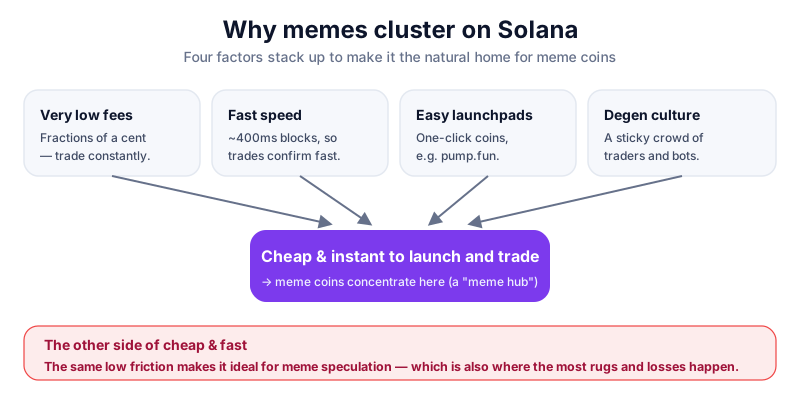
Three things came together. The chain itself is fast and cheap. A wave of 'launchpad' tools made creating a coin trivially easy. And once enough traders and attention gathered in one place, that crowd became its own gravity. Let's take each in turn — and then be just as clear about what that speed costs you.
Cheap fees and fast blocks
The clearest reason is plumbing. Solana settles new blocks in roughly 400 milliseconds and charges fractions of a cent for a typical transaction — often well under a penny. For a trader firing off dozens of small buys and sells in an afternoon, that's the difference between a viable hobby and an impossible one. Compare that with paying Ethereum gas fees of several pounds (or far more when the network is busy) on every single trade, and the appeal becomes obvious.
Low cost changes behaviour. When each trade is essentially free, people make far more of them, chase far smaller moves, and treat the whole thing more like an arcade than an investment. The technical details of how the chain achieves this are covered in how Solana works, but the upshot for meme coins is simple: friction is what kills speculative churn, and Solana removed most of it. One bit of friction it can't remove is tax: in the UK, every one of those trades counts as a taxable disposal, and Koinly can tot up what you owe HMRC.
| What matters for meme trading | Why Solana suits it |
|---|---|
| Cost per trade | Fractions of a cent — you can trade constantly |
| Block time | ~400ms, so trades confirm almost instantly |
| Tooling | Mature launchpads and wallets built for fast token trading |
| Crowd | Most meme-coin traders and bots already gather here |
Cheap and fast is a double-edged sword
The same low friction that makes Solana fun for traders also makes it cheap for scammers to spin up thousands of throwaway coins a day. Low cost lowers the barrier for everyone — including the people trying to take your money.
Launchpads made creating a coin a one-click job
The second big factor was tooling. Around early 2024, 'launchpad' websites turned coin creation from a developer task into something anyone could do in minutes from a phone. The best known of these popularised a model where every new coin starts on a bonding curve — a fixed formula where the price rises automatically as more money flows in — before 'graduating' to a normal decentralised exchange pool once it reaches a certain size.
This mattered enormously. Suddenly there was no need to write a smart contract, seed a liquidity pool by hand, or understand any of the machinery in how meme coins work. You typed a name, uploaded a picture, and your coin was live and tradeable. At peak periods these platforms have spun up tens of thousands of new tokens a day on Solana — most of which vanish within hours.
- Lower barrier to create — minutes and a few cents instead of coding skills and real money.
- A standard launch shape — the bonding curve gave new coins instant, automated liquidity without the creator having to fund it.
- Built-in discovery — these sites became feeds of brand-new coins, so traders flocked there to hunt for the next one.
- Volume, not quality — the overwhelming majority are throwaway jokes or scams that never go anywhere.
Culture and community: the network effect
Technology explains how Solana could host this, but not why it kept winning. The deeper reason is a network effect. Traders go where the action is; the action is where the traders are. Once Solana became the place where meme coins launched and went viral, every new participant — degen trader, bot operator, influencer, scammer — had a reason to be there too, which made it even more the place to be.
Liquidity follows attention. A coin needs buyers and sellers to function, and they were already gathered on Solana. Influencers built audiences around calling Solana launches. Bots optimised for Solana's speed. A whole subculture — its own slang, its own personalities, its own running jokes — grew up around the chain. That culture is sticky in a way that raw technology isn't, and it's a big part of why rival chains have struggled to pull the scene away.
Meme coins are a popularity contest with money attached. The chain with the biggest crowd wins by default — and Solana got the crowd first.
The risks hiding inside the convenience
Here's the part the hype skips. Everything that makes Solana great for meme coins also concentrates the risk. The ease, speed and low cost aren't only conveniences for you — they're conveniences for the people on the other side of your trade.
Rug pulls and scams at industrial scale
When launching a coin costs cents and takes minutes, scams become a volume business. The vast majority of tokens launched on Solana go to zero, and a meaningful share are deliberate rug pulls — the creator drains the liquidity and disappears. Before going near any of them, it's worth reading meme coin risks and red flags and running through how to research a meme coin. The fame of the chain says nothing about the safety of any individual coin on it.
Congestion, volatility and the exit problem
Solana has historically suffered bouts of congestion and even full outages during periods of frenzied activity — exactly when you might most want to sell. Combine that with the wild volatility of meme coins and thin liquidity, and you can find yourself unable to get out at the price you see on screen. The broader trade-offs of the chain are covered honestly in Solana's ecosystem and risks.
Survivorship bias is everywhere here
You hear about the Solana coin that went up 1000x. You never hear about the tens of thousands launched the same day that went to zero. The winners are loud and the losers are silent — which makes the odds look far better than they are. Most people lose.
The bottom line
Solana dominates meme coins because it removed almost all the friction from creating and trading them — cheap fees, near-instant blocks, one-click launchpads — and because that drew in a crowd whose presence became self-reinforcing. None of that makes any particular coin a good idea. The same qualities that make Solana the most fun place to speculate also make it the most efficient place to lose money, get rugged, or be left holding a token nobody else wants.
Understanding why the scene concentrated here is genuinely useful — it helps you read the landscape and spot the patterns. But treat the chain's popularity as marketing, not safety. Crypto is volatile and you can lose everything you put in, and meme coins are the most volatile corner of all. If you ever do go near one, only ever risk money you can afford to lose entirely. — the Latest Crypto team
Key takeaways
- Solana's sub-second blocks and sub-penny fees made constant meme-coin trading viable in a way Ethereum's gas costs don't.
- Launchpads turned coin creation into a one-click, few-cents job, flooding the chain with new tokens.
- A self-reinforcing crowd of traders, bots and influencers gave Solana a network effect rivals struggle to break.
- The same ease and speed concentrate the risk — industrial-scale rugs, congestion, and heavy survivorship bias.
- Chain popularity is not coin safety; meme coins are volatile and most go to zero.
Frequently asked questions
Why are meme coins mostly on Solana and not Ethereum?
Cost and speed. Solana trades confirm in under a second for a fraction of a cent, so traders can buy and sell constantly. On Ethereum, gas fees can make each small trade uneconomic. Once the crowd gathered on Solana, the network effect kept it there. You can compare the two chains in Ethereum vs Solana.
Does Solana being popular make its meme coins safer?
No. The chain's popularity tells you nothing about any individual coin. Most tokens launched on Solana go to zero, and many are outright scams. Treat every coin on its own merits using how to research a meme coin, regardless of how fashionable the chain is.
What are the main risks of trading meme coins on Solana?
Rug pulls and scams launched cheaply at huge scale, thin liquidity that can trap you when you try to sell, network congestion during frenzies, and extreme price volatility. The single biggest trap is survivorship bias — the few winners are loud while the many losers are silent.
Keep reading
What Is Solana? A Plain-English Guide
A beginner-friendly explanation of Solana (SOL): what it is, how it differs from Bitcoin and Ethereum, what it
How Solana Works: Proof of History Explained
A clear look under Solana's hood: how it reaches such high throughput, what Proof of History actually is, the
How Meme Coins Work (Under the Hood)
How meme coins are created, traded and priced — tokens, liquidity pools, market caps and the mechanics that ma