Crypto Regulation Around the World: A 2026 Snapshot
For years, the honest answer to 'is crypto regulated?' was 'it depends where you stand, and ask again next quarter'. That's finally changing. By mid-2026 most major economies have either passed dedicated crypto laws or are weeks away from switching them on. This is a tour, not legal advice — the aim is to help you understand the shape of the rules, not to tell you what's allowed in your situation.
The 20-second version
In 2026 the big jurisdictions are converging on clearer crypto rules: the EU's MiCA reaches full force, the US has carved out which coins are commodities, the UK is building a full regime for 2027, and parts of Asia have passed dedicated laws. Rules differ sharply by country, so where you live still changes what you can legally do.
Why 2026 is a turning point
Regulation tends to follow disasters. The collapses of 2022 — most visibly the FTX collapse and the Terra/Luna implosion — convinced governments that 'wait and see' was no longer a safe stance. The years since have been spent drafting actual laws rather than enforcing old ones by analogy.
The result is a patchwork that is slowly becoming a quilt. Different regions have made different choices about how strict to be and what to prioritise — consumer protection, stablecoins, money-laundering controls, or attracting business. Understanding the broad approach in each major bloc tells you most of what you need to know.
Rules are about firms first, then you
Most crypto regulation targets exchanges, custodians and stablecoin issuers — not individual holders. But those firm-level rules shape your day-to-day experience: which apps will serve you, what identity checks you face, and what protections you have if something goes wrong.
The United States: commodities, securities and stablecoins
For most of crypto's history the US fought a turf war: was a given coin a 'security' (the SEC's patch) or a 'commodity' (the CFTC's)? The uncertainty defined the market, and the long-running XRP case against the SEC became the symbol of it. In 2026 that fog has thinned considerably.
A joint SEC–CFTC interpretive release issued in March 2026 set out, for the first time, a list of major cryptocurrencies treated as digital commodities rather than securities — clarifying who regulates what. In parallel, federal stablecoin legislation has moved into implementation, with reserve, audit and anti-money-laundering rules being written for issuers. The direction is clearer rules and clearer regulators, even if plenty of detail is still being filled in. We cover the longer story in the SEC and US crypto regulation.
Why the commodity question matters
If a coin is a commodity rather than a security, it faces lighter disclosure rules and is easier to list, wrap in an ETF, or build products around. That single classification ripples through the whole market — including the spread of crypto ETFs.
The European Union: MiCA reaches full force
The EU took a very different path: rather than argue case-by-case, it wrote one big rulebook. The Markets in Crypto-Assets regulation — MiCA — gives the whole bloc a single licensing framework, so a firm authorised in one member state can 'passport' its services across all of them. By mid-2026 the staggered roll-out is reaching full enforcement, and providers serving EU customers without a licence are expected to stop.
- One licence, 27 countries — the headline feature is harmonised rules and EU-wide passporting for crypto-asset service providers.
- Stablecoin rules — issuers face reserve, redemption and transparency requirements, the strictest part of the regime.
- Consumer protections — clearer disclosures and conduct rules for exchanges, custodians and brokers.
- A sequel is coming — officials have signalled a follow-up ('MiCA 2') to cover gaps such as decentralised finance and staking.
MiCA is widely seen as the most comprehensive framework anywhere. For a deeper look at how it's structured and who it covers, read what is MiCA regulation.
The United Kingdom: a full regime, arriving in stages
The UK chose to fold crypto into its existing financial-services architecture rather than create a parallel system. The Financial Conduct Authority (FCA) is the lead regulator, and Parliament has amended financial-services law to bring crypto firmly inside the regulatory perimeter.
Through late 2025 and 2026 the FCA consulted on rules for trading platforms, intermediaries, lending and borrowing, staking and decentralised finance, with the full regime targeted to take effect by late 2027. A 'UK nexus' test is designed to capture overseas firms that market to UK consumers, so the rules reach beyond British-based companies. The practical upshot today: tighter promotion rules, stricter onboarding, and a clear plan that firms must build toward. Our standing explainer is the FCA and UK crypto rules.
Promotions are already restricted
Even ahead of the full regime, UK rules on how crypto can be advertised are already live — which is why you'll see prominent risk warnings and 'cooling-off' steps when signing up to UK-facing platforms. If you're buying here, see how to buy crypto in the UK.
Asia: many models, moving fast
Asia is not one story — it's several. Some governments are courting the industry; others are cautious; a few have banned large parts of it outright. What's striking in 2026 is how many ran major reforms at once.
| Jurisdiction | Broad 2026 stance |
|---|---|
| Japan | Reclassified crypto as a financial product and reformed its tax treatment; long-established licensing regime. |
| Hong Kong | Pro-industry framework; issued its first stablecoin licences and runs a growing list of licensed trading platforms. |
| South Korea | Advancing a Digital Asset Basic Act with strict stablecoin reserve rules, building on earlier user-protection law. |
| Singapore | Open to institutional and innovation use, but cautious on retail — limits on retail trading and crypto advertising. |
If you want country-level detail, we have dedicated guides to crypto in Japan, crypto in South Korea and crypto in the UAE. The wider point: 'Asia' tells you almost nothing on its own — the rules in Tokyo, Singapore and Seoul can differ enormously.
The rest of the world, and what to watch
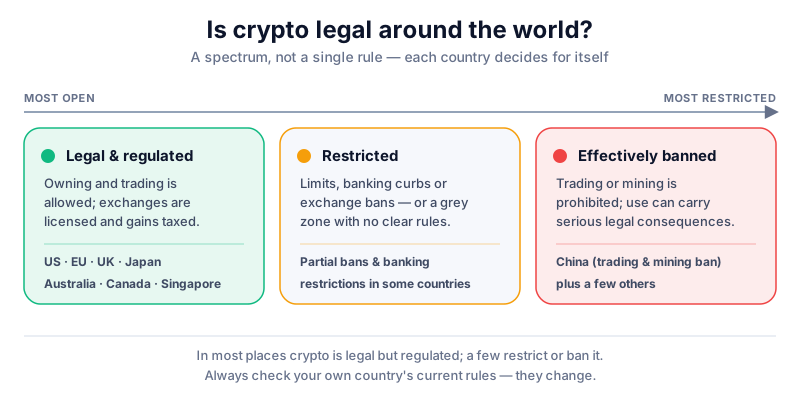
Beyond these blocs, approaches range from enthusiastic adoption to outright restriction. Some countries have embraced crypto for payments and remittances; others have banned trading or mining. We keep a broader map in is crypto legal around the world, and cover emerging markets such as crypto in Nigeria and crypto in Brazil.
The themes that cut across everywhere
- Stablecoins first — almost every regime is racing to regulate stablecoins, because they touch the traditional banking system most directly.
- Identity checks are spreading — expect KYC on regulated platforms to become near-universal.
- Coordination is hard — global bodies warn that mismatched national rules create 'regulatory arbitrage', where firms shop for the friendliest jurisdiction.
- Rules don't remove risk — regulation can reduce fraud and improve disclosure, but it cannot make a volatile asset safe.
The bottom line
The era of crypto operating in a legal grey zone is closing. The EU has its rulebook, the US has clarified who regulates what, the UK is wiring crypto into its financial system, and much of Asia has passed dedicated laws. That's genuinely good news for clarity — but it does not change the underlying nature of the asset.
Regulation is about the firms you deal with and the protections you have, not a guarantee about price or outcome. Wherever you live, the rules are still evolving, they differ by country, and none of them remove the basic fact that crypto is highly volatile and you can lose money. If you're acting on anything specific, check your own jurisdiction's current rules — and, where money or tax is involved, take qualified professional advice.
Reconciling a year of trades by hand is miserable. Koinly connects your exchanges and wallets, applies the rules the taxman expects, and produces a ready-to-file report — free to preview, you only pay to download it.
Key takeaways
- By 2026 the major economies have clearer crypto rules: the EU's MiCA, a US commodity/security split, a UK regime building toward 2027, and dedicated laws across Asia.
- Most regulation targets exchanges, custodians and stablecoin issuers — but it shapes which apps serve you and what protections you get.
- Rules differ sharply by country, so where you live still determines what you can legally do.
- Stablecoins and identity checks (KYC) are the fastest-moving themes almost everywhere.
- Clearer rules reduce fraud and improve disclosure, but they do not make a volatile asset safe.
Frequently asked questions
Does regulation make crypto safe to own?
No. Regulation can reduce fraud, force better disclosure, and give you clearer recourse if a regulated firm fails — but it cannot make the asset itself less volatile. Crypto prices can still fall sharply, and you can lose money regardless of how well-regulated the platform is.
Which region has the strictest crypto rules in 2026?
There's no single answer, because regimes prioritise different things. The EU's MiCA is the most comprehensive single framework; the UK is building a detailed regime inside its financial-services law; and several Asian jurisdictions have very strict stablecoin reserve requirements. 'Strict' depends on which activity you're looking at.
Do these rules apply to me as an individual holder?
Mostly indirectly. Crypto laws largely regulate firms — exchanges, custodians and issuers — rather than individuals. But they affect which services will accept you, what identity checks you face, and the protections you have. Your personal obligations, especially tax, are set by your own country's rules.
Keep reading
What Is MiCA? The EU's Crypto Regulation Explained
A plain-English guide to MiCA — the EU's Markets in Crypto-Assets regulation: what it covers, how it affects e
The SEC and US Crypto Regulation Explained
How the SEC and other US agencies regulate crypto: the securities question, the SEC vs CFTC divide, major enfo
The FCA and UK Crypto Rules Explained
How the Financial Conduct Authority regulates crypto in the UK: registration, the financial-promotions regime,